

A user in the field of cable assembly for control technology has already strategically modernized its production operations, relying on machine solutions from Zoller + Fröhlich GmbH:
The cutting machine Z+F EVOCUT® + Z+F EVOFEED® enables the sequential processing of various wires and wire colors to the desired length, without the traditional setup times associated with wire changes or program modifications. As a result, even highly varied production runs can be carried out efficiently. Positioned upstream of the cutting machine, the Z+F WireDancer® simultaneously ensures the smooth unwinding of wires from cartons or spools.


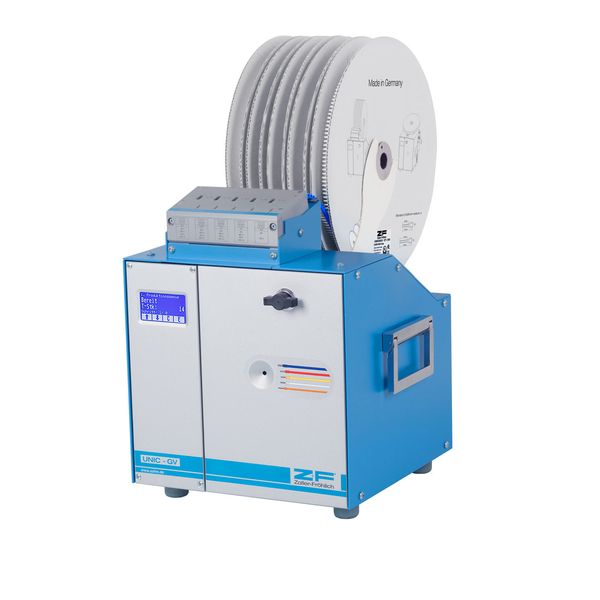
The Z+F UNIC-GV is subsequently positioned at the cutting machine and handles the stripping and crimping of insulated wire ferrules in the cross-section range of 0.5 to 2.5 mm² (AWG 20–14). With the aid of the Z+F UNIC-GV, the user can process the aforementioned cross-sections without tool changes or manual adjustments, thereby ensuring a high degree of operational flexibility.
By implementing these systems, the customer was able to significantly automate their processes and enhance process reliability. In particular, the reduction in changeover times and the flexible processing of various cable types represent distinct advantages in daily operations.
When automation reaches its limits: manual visual inspection
Despite the high degree of automation, however, one critical process step remained: the visual inspection of the crimped wires.
This control continued to be performed manually by employees. This entails several challenges:
Particularly with high production volumes and short cycle times, the risk increases that defective parts will go undetected and only be discovered during later manufacturing stages.
Integration of camera-based quality inspection
To close this gap, visual inspection was specifically automated.
The Z+F Visual Control System (VCS), also part of the Zoller + Fröhlich portfolio, is used for this purpose; it is utilized on the Z+F UNIC-GV following the crimping process. The wire ends are optically captured and evaluated based on defined quality criteria.
In this specific case, the system enables, among other things, the reliable detection of:


Deviations are displayed immediately, enabling a direct response within the process. Furthermore, the determined results are saved in real time, allowing the customer to demonstrate the quality of production at a later date. Upon request, the Z+F VCS can also be used to inspect other contacts.
Impact on process stability and quality assurance
Integrating the Z+F VCS into the existing Zoller + Fröhlich manufacturing solution offers several advantages:
In particular, the interplay between automated processing and camera-based inspection ensures end-to-end quality assurance throughout the entire process.
Expansion of existing manufacturing solutions through optical inspection
This case study demonstrates that, even in highly automated manufacturing environments, individual manual process steps can become a limiting factor. Visual quality control frequently represents an underestimated weak point in this regard.
This gap is closed through the targeted addition of an optical inspection system to Zoller + Fröhlich’s existing machine solution. Quality assurance is brought closer to the actual manufacturing process, errors are detected earlier, and the overall economic efficiency of production can be sustainably improved.